
How a leaf stays in the blue
Anna Atkins’s cyanotypes invite us to look closely at the point where a plant meets a sheet of paper.
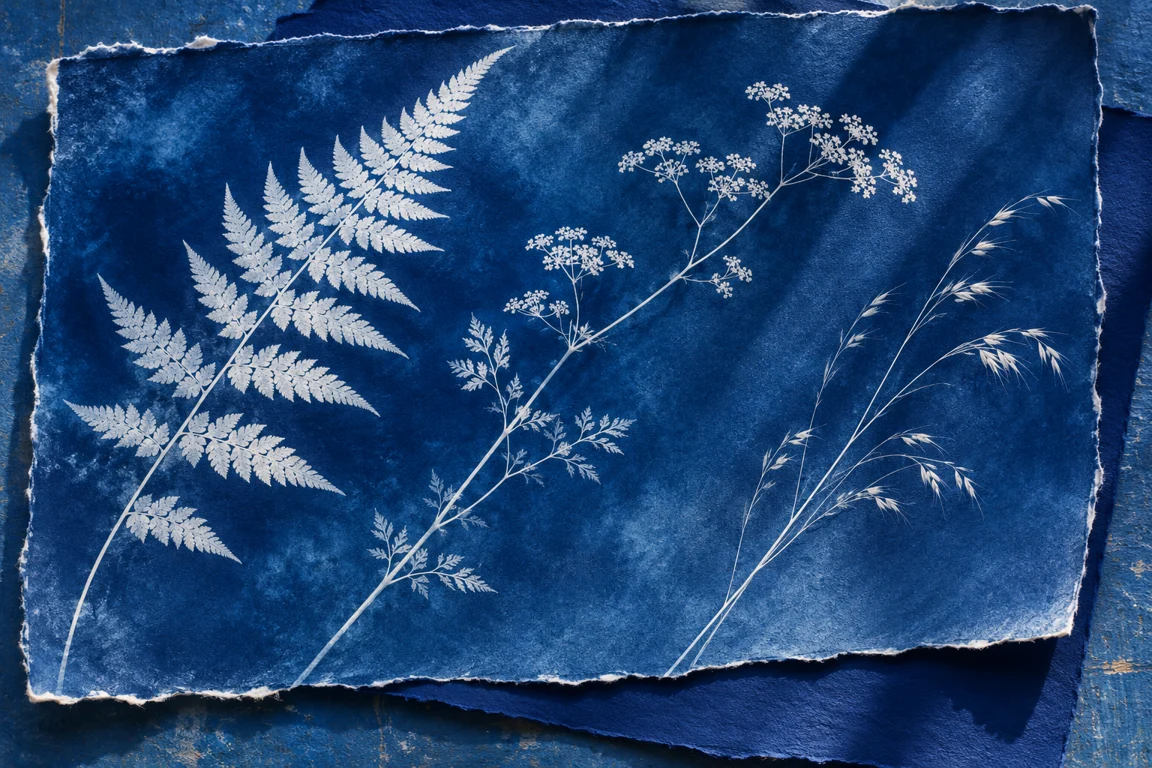
When you look at a botanical cyanotype, try covering the caption. What catches your eye first: the whole plant, or the small patch of blue between two branches?
After the leaf is lifted
A cyanotype can make an image without a camera. An object shields part of a light-sensitive sheet. After exposure and washing, the uncovered areas turn blue and the plant leaves a pale outline.
The British botanist Anna Atkins used the process to record algae. In 1843 she began publishing Photographs of British Algae: Cyanotype Impressions. Direct contact between specimen and paper brought even the smallest branches onto the page.
Take time at the edges
Pick one branch and follow it from the base to the tip. Where it divides, blue works its way into the gap. Where two leaves overlap, their pale shapes run together.
A label for one of these works might start with a small invitation: ‘Follow the longest branch to its first fork.’ Once you know how the image was made, look again at that patch of blue.